It’s no secret that Dominican Spanish is a different breed. People talk faster, use a lot of slang, and even have different accents depending on which part of the DR they’re from. This is a quick list of essential Spanish phrases and pronunciation tips you should master to feel more at ease during your next trip to any Spanish speaking country. If you already speak decent Spanish and just want to sound more Dominican, be sure to check out my Dominican slang guide for the real phrases locals actually use.
Spanish Letter Pronounciation
Before we get into the phrases themselves, it helps to understand a few key pronunciation basics, because Spanish sounds very different from English—especially in the Dominican Republic. Many Spanish letters are pronounced similarly to English, but there are a few important differences that can completely change how a word sounds. Many Spanish letters look like English, but they’re pronounced very differently. Spanish sounds are short, clean, and consistent, which actually makes pronunciation easier once you learn the patterns.
Vowels
Spanish vowels never change sounds like they do in English. Each vowel always has one sound only.
- A — as in agua
Pronounced “ah”, like father - E — as in mesa
Pronounced “eh”, like bet or get (not like “ee”) - I — as in vino
Pronounced “ee”, like see or neat - O — as in solo
Pronounced “oh”, like told (without the heavy English “w” sound) - U — as in tú
Pronounced “oo”, like food
Consonants
- R — as in pero
A soft tap, similar to the middle sound in ladder or butter - RR — as in perro
A fully rolled R (strong vibration) - J — as in jugo
Pronounced like a strong, breathy H, not a soft English J - H — always silent
Hola sounds like “ola” - T & P — breathless
No puff of air like in English (this is why Spanish sounds smoother)
Essential Spanish Basics for the Dominican Republic
Before you even worry about slang or fast Dominican Spanish, these are the absolute must-know words that will get you through any interaction with kindness and respect. Even if you pronounce them imperfectly, locals truly appreciate the effort.
Basic Greetings
- Hola
Hello - Saludos
Greetings - Buenas
Casual hi / what’s up (very common in the DR)
- Buenos días
Good morning - Buenas tardes
Good afternoon - Buenas noches
Good evening / good night - Adiós
Goodbye
Polite Words You’ll Use Every Day
- Por favor
Please - Gracias
Thank you - Con permiso
Excuse me (to pass by someone) - Disculpa
Excuse me (used to get someone’s attention) - Perdón
Sorry (used for quick, small accidents like bumping into someone or interrupting a conversation)
Getting Around: Public Transportation
If you’re coming to the DR and want to save a lot of money, public transportation will be your best friend. While Uber is available in all major cities and is much cheaper than in the States (usually just a few dollars per ride), traveling between multiple cities can add up fast—especially if you’re traveling solo.
Using guaguas and carros públicos (think shared Ubers that you don’t have to order in advance) will save you a huge amount of money. If you want a full breakdown of how to catch a guagua, average costs, and what to expect, check out my complete guagua transportation guide for detailed route info, safety tips, and more in-depth Dominican Spanish travel phrases.
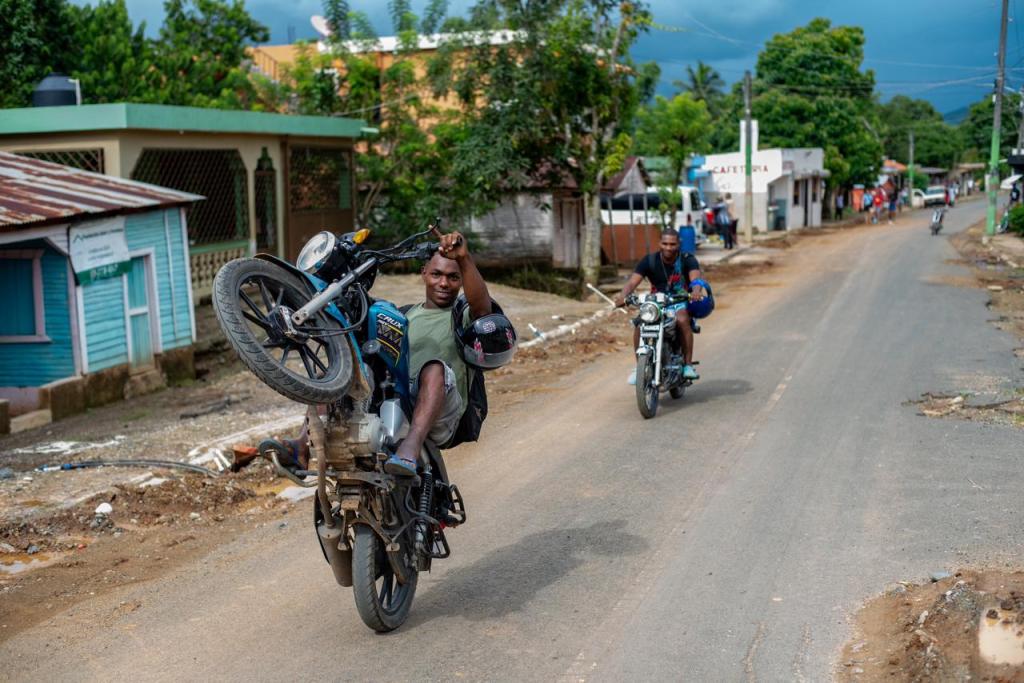
Motorcycles are extremely common in the Dominican Republic and are a very cheap way to travel short distances—but I strongly advise against using them. I’ve been in a motorcycle accident, have been hit by one as a pedestrian, and personally know people who have died in moto-related crashes. Due to weak traffic enforcement and poor road safety, motorcycles are one of the leading causes of death in the country. The risks are not worth it.
Essential Transportation Phrases
- ¿Cuánto cuesta?
How much does it cost? - Déjame aquí, por favor
Drop me off here, please - Me quedo
I’m getting off / I’m staying here (not going further) - ¿Para (pa) dónde va?
Where is the guagua/taxi going?
(“Pa” is the Dominican shortcut for “para”) - Voy para (pa) ___
I’m going to ___ - ¿Está lleno / llena?
Is it full?
Ordering Food
While you’re in the DR, you’re definitely going to need to know how to order food. These are some of the most useful Dominican Spanish phrases for restaurants, colmados, and street food stands.
- Dame / Me das ___
Let me have ___
(It’s not impolite to use dar when ordering in Spanish—it’s completely normal.) - Para llevar
To go - Para aquí
For here - Con / sin ___
With / without ___ - La cuenta, por favor
The check, please - Tenedor / cuchara
Fork / spoon
Shopping & Bargaining
While you’re in the DR, you’ll definitely want to shop for clothes, souvenirs, and the country’s national gemstone—larimar. If you’re in Santo Domingo, you can check out malls like Ágora Mall, Galería 360, or BlueMall, or head to the Zona Colonial to browse outdoor street vendors and artisan markets.
At street vendors and souvenir stands, it’s completely acceptable (and expected) to negotiate—but not in malls, supermarkets, or fixed-price stores.
Essential Shopping & Negotiation Phrases
- ¿Cuánto cuesta?
How much does it cost? - Muy caro
Very expensive - Dame el precio real
Give me the real price - Solo tengo ___
I only have ___ - Bájale un chin (very Dominican)
Lower it a little - ¿Me lo puedes dejar más barato?
Can you make it cheaper for me? - Estoy solo mirando
I’m just looking - Después vuelvo
I’ll come back later - Me gusta, pero está caro
I like it, but it’s expensive - ¿Tienes otro color / tamaño?
Do you have another color / size?
Safety & Emergencies
The Dominican Republic is a generally safe place as long as you blend in and don’t flash money around. I’ve never had to say any of these phrases, but it’s always smart to be prepared for emergencies.
- Llama a la policía
Call the police - Me robaron
They robbed me - Estoy perdido / perdida
I’m lost
(Use perdido if you identify as male, perdida if female) - Ayúdame, por favor
Help me, please
Dealing with Street Comments
Sexual harassment and catcalling are unfortunately fairly common on the streets in the Dominican Republic—especially for women walking alone. Unlike in the United States, catcalling is more normalized here. You might hear things like “Diablo mami,” “¿Estás casada?” or “Ven acá rubia/morena/flaca.”
You can always ignore it, but if someone keeps bothering you, these phrases can help get them of your back.
- No me molestes
Don’t bother me - Tengo novio / novia / esposo / esposa
I have a boyfriend / girlfriend / husband / wife - Dame banda
Leave me alone / back off (very Dominican)
Final Thoughts: Dominican Spanish Made Simple
Learning even a little bit of Spanish—especially Dominican Spanish—can completely transform your experience in the DR. From ordering food and catching guaguas to setting boundaries and handling everyday interactions, these phrases will help you feel more confident, independent, and connected to the culture around you. You don’t need to be fluent— effort goes a long way. And the more you use it, the easier (and more fun) it becomes. If you already speak Spanish, and are now looking to master Dominican slang, check out this guide.


 Wandering Morena
Leave a comment